Pomodoro & Focused Sprints
Big tasks are intimidating; twenty-five minutes is not. Work in sprints, rest on purpose.
The Pomodoro Technique — Francesco Cirillo, a kitchen timer shaped like a tomato, the late 1980s — is the most durable focus trick ever invented because it solves the starting problem. You don't commit to writing the report; you commit to twenty-five minutes. Anyone can do twenty-five minutes.
The rhythm: pick one task, work a timed sprint, take a short break, repeat. After a few rounds, a longer break. The timer does two jobs at once — it makes starting easy, and it makes stopping guilt-free (the break is part of the method, not slacking).
How to practice it in Fokus
The Focus Timer ships in Pomodoro mode by default:
Start a sprint on a real task
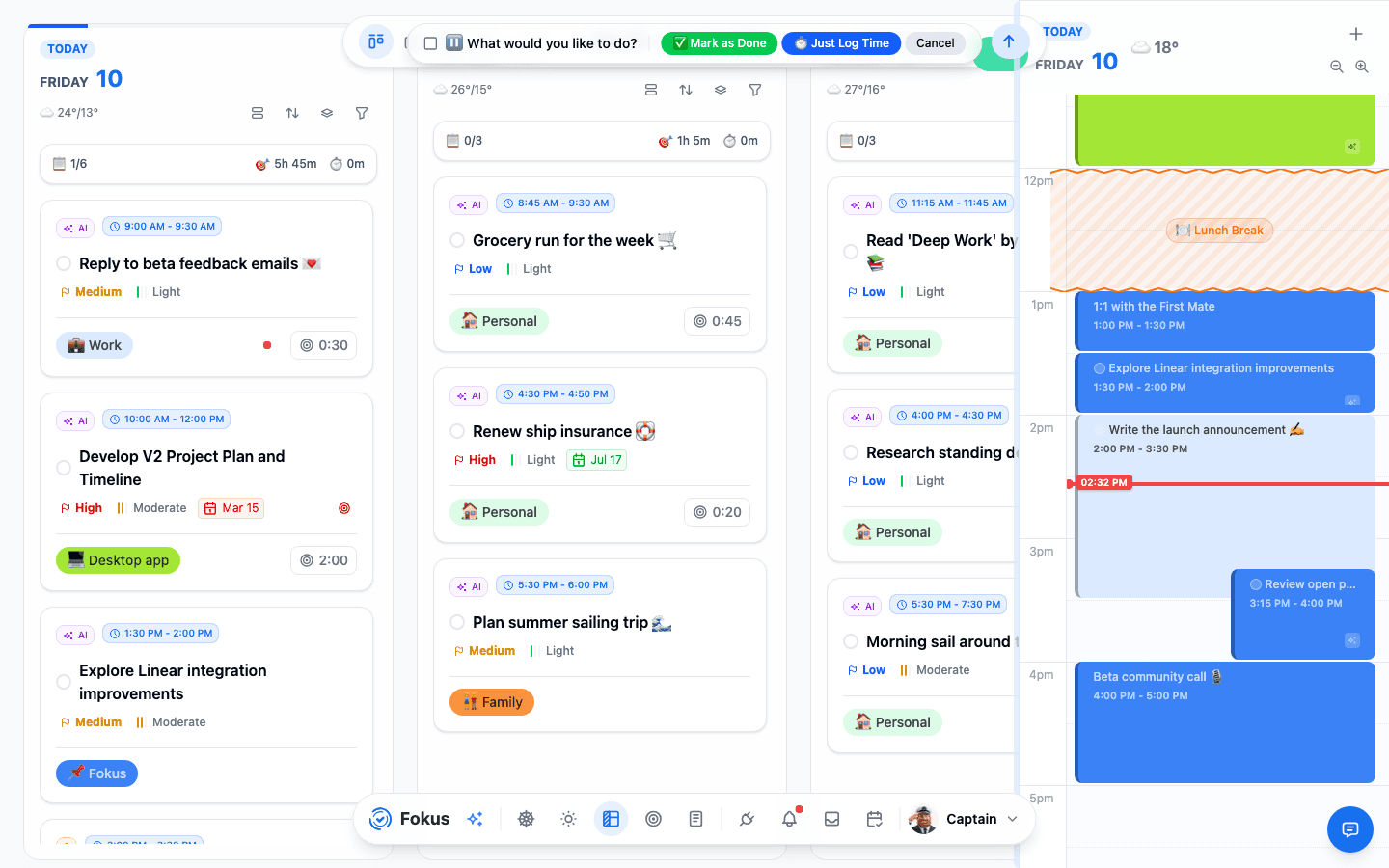
Hover any task card and hit Start Timer — the sprint is attached to the task, not floating in the void. The bar in the header counts your sprint against the task's estimate.
Honor the bell
When the work phase ends, the timer walks you into the break. Stand up. Look out a window. The break is the technique.
Close honestly
Done early? Stop & Save → Mark as Done (confetti included). Out of sprints but not finished? Just Log Time — the minutes still land on the task, and your estimates get smarter for auto-scheduling.
Making sprints fit real work
- Size tasks in sprint units. A 25-minute estimate is one pomodoro; 50 is two. When a task won't fit in a handful, that's the signal to split it — subtasks or chunking exist for exactly this.
- Deep session instead? Switch the timer to Continuous mode when a bell every half hour would hurt more than help — see Deep Work.
- Protect the sprint. Pair the timer with Immersive Mode or Deep Fokus DND so the twenty-five minutes are actually yours.
- Review the score. The End-of-Day Review shows tracked vs. estimated time — the honest history of your sprints.
How is this guide?